As I mentioned last week, I recently talked with Rick Klau of Feedburner and dug into where all the subscriber numbers come from. From that came my write-up at Search Engine Land about the details of Feedburner subscriber counts. As I said in the article, fluctuations tend to be due to client-based readers (if people don’t turn on their computers one day, they don’t get counted) and occasional non-reporting from a feed reader (I may not notice when My Yahoo doesn’t report my 15 readers but I’ll definitely notice when Google Reader doesn’t report my 513).
Does posting more often help?
This means that new posts shouldn’t impact numbers because the feed readers count subscribers based on actual number subscribed (web-based) and number of requests to see if new posts exist (client-based). Whether or not a new post is there to pull in doesn’t make a difference. (Of course, if you have a new post that people like and link to, that may cause others to find it who then subscribe to your blog, so posts can definitely increase numbers. It’s just that the feed readers themselves don’t count based on whether they actually pull a new post or not.)
Rick said not to fixate on day to day numbers, but instead look at overall trends, so I thought it would be fun to take the opposite of his advice and fixate on the details. Last week, my numbers looked like this:
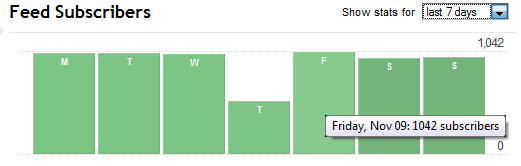
(Thursday is so low because Google Reader didn’t report numbers that day.)
And for the entire month, pulling out a select group of feed readers, my numbers looked like this:
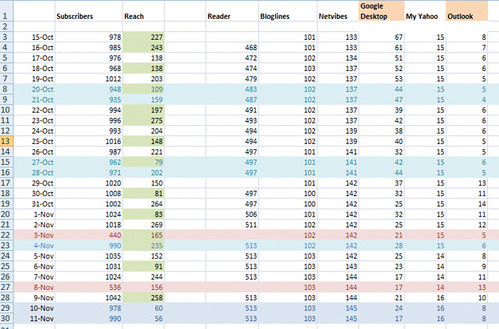
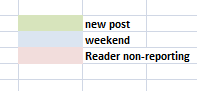
(Google Desktop and Outlook are client-based, so fluctuate based on whether or not the person turned on the computer and opened the application.)
For the month, my overall subscriber numbers stayed pretty constant, with a slight upward trend. (One interesting thing I noticed that there are two days that Google Reader didn’t report numbers that impacted overall Feedburner numbers (Nov. 3rd and Nov. 8th); but two other days when Google Reader non-reporting didn’t impact overall numbers (Oct 15th and Oct. 29th). Maybe Rick will come by and let us know what was up with that.)
But how many are reading?
Looking at subscriber numbers over time isn’t the same as looking at site visits over time. Subscriber numbers tend to add up. You stop reading my blog, you may not unsubscribe. You might just stop clicking on the site in your RSS reader. You start using Google Reader instead of Bloglines, that old Bloglines subscription continues to be counted. Which means that it’s not all that likely that your subscriber numbers will go down over time. If they stay relatively flat and just creep up a little like mine are doing, you may not be getting new subscribers, so big upward spikes are obviously good.
Reach, however, does tell you how many people are reading your feed on a given day via a feed reader, so that may be a better number to use when measuring adoption over time. Unlike total subscriber numbers, reach numbers do seem to be impacted by whether or not a new post is available. And that makes sense, if you don’t have anything new to read, you won’t have many people reading it. Not everyone reads their subscriptions every day, of course, so you’ll get some people catching up on old posts on days you haven’t published anything new.
Here’s how much reach numbers look and it’s clear that they’re all over the place, probably based on when I have new content.
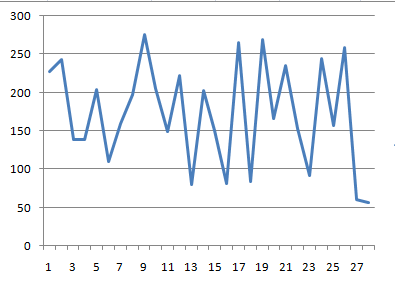
When you post can make a difference here. For instance, on several days, I posted at night, so most people seemed to have read those posts the next day (such as October 27th and October 30th).
It also appears that days that a particular feed reader doesn’t report numbers impacts the subscriber counts but not the reach counts. This makes sense also since Feedburner aggregates subscriber numbers reported to it, but gathers reach numbers itself.
Looking at per-feed reader numbers
My numbers seem to tell me that while my subscriber counts have gone slightly up over the last month, the actual number of readers I have via subscription have remained basically constant. The last two days look a little depressing, but I’m betting the low numbers are due to a combination of no posts and weekend reporting.
Another thing these numbers show is that web-based feed readers are fairly constant, so if one of them doesn’t report numbers for a given day, you can pretty confidently add the previous day’s number to the total Feedburner count to get accurate stats. With this method, I can infer that I actually had 1049 subscribers on November 9th. Of course, you could just wait until the next day. (Ack! I mean, yes, of course — wait. Perfectly reasonable.)
One thing that’s interesting is that while most of the feed readers trended slightly up (Google Reader went from 468 to 513 and Netvibes went from 133 to 145), Google Desktop was sharply down over the period (67 to 17 — see the purple line in the graph below). Is this because Google Desktop users in particular aren’t fans of the blog or because overall Google Desktop usage is down?
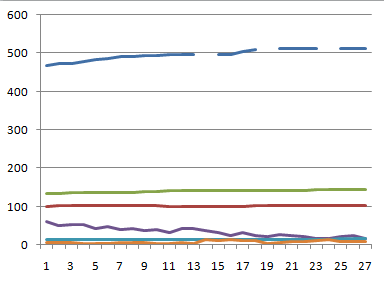
And that’s the other tricky thing with these types of numbers. You are at the mercy of the feed reading services, and changes in usage or reporting may impact the numbers in ways you can’t control.
Overall though, up and to the right is probably a good sign and Rick clearly is right when he says not to obsess about the minutia. Fortunately, I’ve done that for you.